

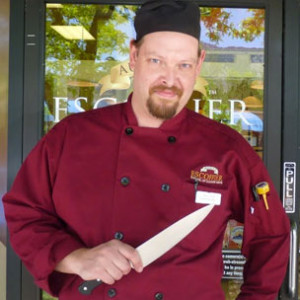
“I chose Auguste Escoffier School of Culinary Arts because of the hands-on environment, attention to detail and the reputation of the school. My education far exceeded my expectations. The Chef Educators really care about teaching and are open to working with any student that wants help. My class was made up of people with all levels of skill and from all parts of the country. This really enhanced the experience, because we learned from each other.”*
Aaron Lande
Program Highlights

Hands-On Training

Small Class Sizes

Entrepreneurial Curriculum

Farm To Table® Experience

Culinary Industry Externship

Experienced Chef Educators

Career Services Support

Nationally Accredited
Wyl L., Culinary Arts Graduate*
Associate of Applied Science Degree in Culinary Arts:
60 Weeks

24 weeks of hands-on training

Additional lecture courses

Exciting 6-week Farm To Table® Experience

12 weeks of industry training through externship
Curriculum
Culinary Foundations
The Culinary Foundations class begins with course work concentrating on food safety and sanitation in the professional kitchen. The class focuses on the importance of proper hygiene, food handling, food storage, cleaning, pest control and HACCP in a food service operation are explored. The State Food Safety exam is administered as part of this course.
Additionally, the historical background of the culinary arts profession are studied and students will gain an introduction to the professional kitchen by tracing the origin of classical cuisine and gaining an overview of the development of modern foodservice. Students also start to become acquainted with tools, utensils, and equipment and discuss kitchen layout.
Basic cooking techniques, culinary terminology, equipment operation, the use and effect of heat, and seasoning principles are taught in this course. This course also includes fundamental knife skills, cutting techniques, and the concept of mise en place. Conversion methods and standard measurements, as well as yield cost analysis; portion sizing and food costing are covered.
Culinary Arts
In the Culinary Arts course, students build upon the foundations taught in Culinary Foundations. The course begins with an overview of breakfast cookery including classical American breakfast items such as egg cookery, quick breads, muffins, biscuits, and breakfast meats.
Students will study the art and science of baking and pastry arts and learn to prepare items ranging from bakeshop staples to international restaurant quality desserts covering the theory and chemistry of the pastry arts. Cakes, tortes, icing, and decorating techniques are also covered. Charcuterie and Garde Manger are also covered in this course. Classic charcuterie includes items such as pâtés and terrines, and Garde Manger will cover buffet presentations and the preparation of hot and cold hors d’oeuvres.
Regional Cuisines
In this course, students will explore the history and culture underlying other gastronomic areas of the globe. Students will replicate some of the classic dishes from East, South, and Southeast Asia. Students will also practice preparing Middle Eastern as well as some North African recipes. This course also includes foods of the Americas including current food trends and the culinary and cultural influences of Central America and the Caribbean.
Farm to Table® Experience
The Farm To Table® Experience course provides the students with a hands-on experience on a working farm/ranch or vineyard/orchard. The Instructor conducts the lecture and lab activities to coincide with the harvested item(s) for a catered event executed by the students on-site. The students, under the direction of a Farmer/Rancher collect or harvest foods and/or proteins for the students’ lab activities.
This class also focuses on the ever growing relationship between the chef and the farm/factory/ranch. This course will result in a daily lab menu production of selected sustainable and/or organic foods. Also presented will be concepts of traditional and nontraditional farming and sourcing for vegetables, as well as the impact of land and sea animal-based food sourcing as practiced globally.
Restaurant Operations
Three out of five restaurants fail within five years of opening, often due to money mismanagement; this course gives students the skills to not only keep their restaurant in business but also turn a profit.
In this course, students study the hierarchy of management in food service, and the skills needed to succeed as a manager: training employees, motivating them, disciplining them, and creating a safe and positive work environment. This course explores different types of menus (including both food menus and beverage menus) and their applications. Aspects of menu planning and design, ranging from visual design to price analysis to making use of available resources are covered.
The menu is both a financial tool and a communication tool, and students learn about its uses as both. Students are introduced to accounting and managing budgets, especially as it relates to the hospitality industry. Students learn how to minimize costs and maintain a full range of customer services.
Culinary Entrepreneurship
This course covers such topics as business planning, pricing, credit management, government regulation, and legal concerns. Business ethics and the crucial role and importance of management and leadership are also covered. For the final project for this course, the student will complete and present a business plan for a food service operation.
Professional Communications
The Business & Professional Communications course emphasizes the principles and practical application of effective professional communication behaviors within professional, business, and organizational contexts. In addition to identifying the importance of effective communication skills to the hospitality industry, communication styles and effective listening methods are addressed. Students will create and present oral presentations including cooking demonstrations, and special occasion speaking. Listening skills, verbal and nonverbal communication, conflict resolution, cultural differences in communication, and debate techniques are also covered.
Technical Writing
Technical Writing prepares students to write in the hospitality and foodservice professions. In a professional setting, writing provides readers information they need in a format they can understand.
Unlike most academic writing, in which students demonstrate their learning to a professor who already knows the subject, in technical communication the writer is the expert, and the readers are the learners. In the hospitality and foodservice industries, students and professionals write a variety of documents for supervisors, colleagues, and customers such as explaining a problem or product, preparing a proposal, or illustrating a project.
This course teaches students to adapt their writing to different audiences and purposes. This course outlines strategies for making subjects clear to readers who need to understand them. To communicate effectively with an audience, writing must meet rigorous editing standards, in addition to writing in a clear, concise style and presenting information logically.
World History & Culture
Throughout history, food has done more than just provide nourishment. From prehistoric times to the present day, food and the pursuit of it has had a transformative role in human history. Food has impacted societal organization, industrial development, military conflict, and economic expansion. As epicure and gastronome, Jean-Anthelme Brillat-Savarin stated, “Gastronomy governs the whole of human man.” In addition, food also serves a role in the cultural development of religion, economics, and politics. This course examines the role of food and its contribution and influence over history, culture, religion, economics, and politics. Food customs and attitudes are also explored, as well as, the social awareness selected food patterns and customs.
The Science of Nutrition
In the Science of Nutrition course, the basic principles of nutrition are investigated. Emphasis is placed on the nutrients, food sources, and their utilization in the body for growth and health throughout life. Contemporary and global nutritional issues are also discussed.
College Algebra
MA130 is an intermediate-level course in algebra. This course includes topics in equations and inequalities, graphing lines and circles, functions and their graphs, polynomial and rational functions, and exponential and logarithmic functions.
Culinary Industry Externship I
This course provides opportunities for real life experiences in an operational restaurant or related business and builds on the skills and techniques covered in previous courses.
Culinary Industry Externship II
This course provides additional opportunities for real life experiences in an operational restaurant or related business and builds on the skills and techniques covered in previous courses.

“If anyone is serious about learning the culinary arts, they should consider Escoffier. I was honored to work with many great chefs in school and learn from them. Our chef instructors bring their unique perspectives and backgrounds to the table and are all very dedicated to transferring their valuable knowledge to the students. School administration staff also works hard to pave the path of success for every individual in school.”*
Mahsa Savadkouhi, Culinary Arts Graduate
Farm To Table® Experience
The 6-week Farm To Table® Experience provides students with an in-depth knowledge of where food comes from, the advantages of buying local, various farming and production methods, and how to make the best sustainable and ethical ingredient choices throughout their culinary careers.
Farm Days
Farm Days
Visiting a farm or food procurement facility to see specific parts of the food cycle; some of these are tours of facilities and others are very hands-on.
Kitchen Days
Kitchen Days
Students work in the kitchen to apply the concepts and techniques that they have learned from previous classes to new material gained from the farm days.
Culmination Days
Culmination Days
Students work in teams to plan and execute an event for friends and family within a specified budget.
Farm To Table® Experience Kitchen Days
Where Does Your Food Come From?
Discussion about product sourcing, fabrication, processing, types of farming, history and modernization of food processes.
Whole Animal Butchery
Discussion of butchery processes and practices; explanation of technique and primal/sub primal cuts.
Food Service Operations
Discussion of food service operation types, front of house service, kitchen processes, basic management principles; students plan and prepare for culmination and conduct Quick Fire drills in the kitchen to get used to traditional line cooking operations and stations.
Sustainable and Ethical food sourcing
Discussion of sustainable food sourcing practices; debates about efficacy and other aspects of these practices; students engage in exercises to evaluate proteins raised and processed in a variety of ways (i.e. conventional vs grass fed beef, etc.)
Event Planning and Execution
Discussion of event types and basic procedures for planning food and beverage events; students work as a team to prepare for their culmination events including all menu development and design, product procurement, budgeting, service, and food preparation tasks.

“Now when I cook food I think about where it came from – the blood, sweat, and tears, including my own farm – that helped bring it to me. We have this romantic idea of what it means to farm – the idealistic picture that is plastered on the outside of salad dressing at the market. Reality is it’s a 14-hour day; it’s hard, you know. My respect for what it means to farm has deepened and matured, therefore when I cook, I am now experiencing a deeper connection: a sanctity. Now, when I cook food I think about where it came from – the blood, sweat, and tears, including my own farm – that helped bring it to me. With that same sense of respect, that is how I approach preparing food.”*
Marcus McCauley, Culinary Arts Graduate, Executive Chef & Farm Manager, McCauley Family Farm
AN INSIDE LOOK INTO THE FARM TO TABLE EXPERIENCE®
A Typical Week at Escoffier
25 hours per week on campus
5 to 10 hours per week for work outside of class
Class format consists of research, planning, discussion, experience, feedback and reflection
4 kitchen courses and additional lecture courses and 12 week industry externship experience
Online interface for course materials so all resources are in one place
Tuition
TOTAL PROGRAM COST:
$40,535*
*Total program cost includes tuition, uniforms (non-refundable), toolkit (non-refundable), and an optional non-refundable technology fee (non-refundable). The Associate of Applied Science Degree in Culinary Arts cost also includes coursepacks. The cost of books is not included. Students may choose to purchase books when enrolling. For more cost details, see the catalog.
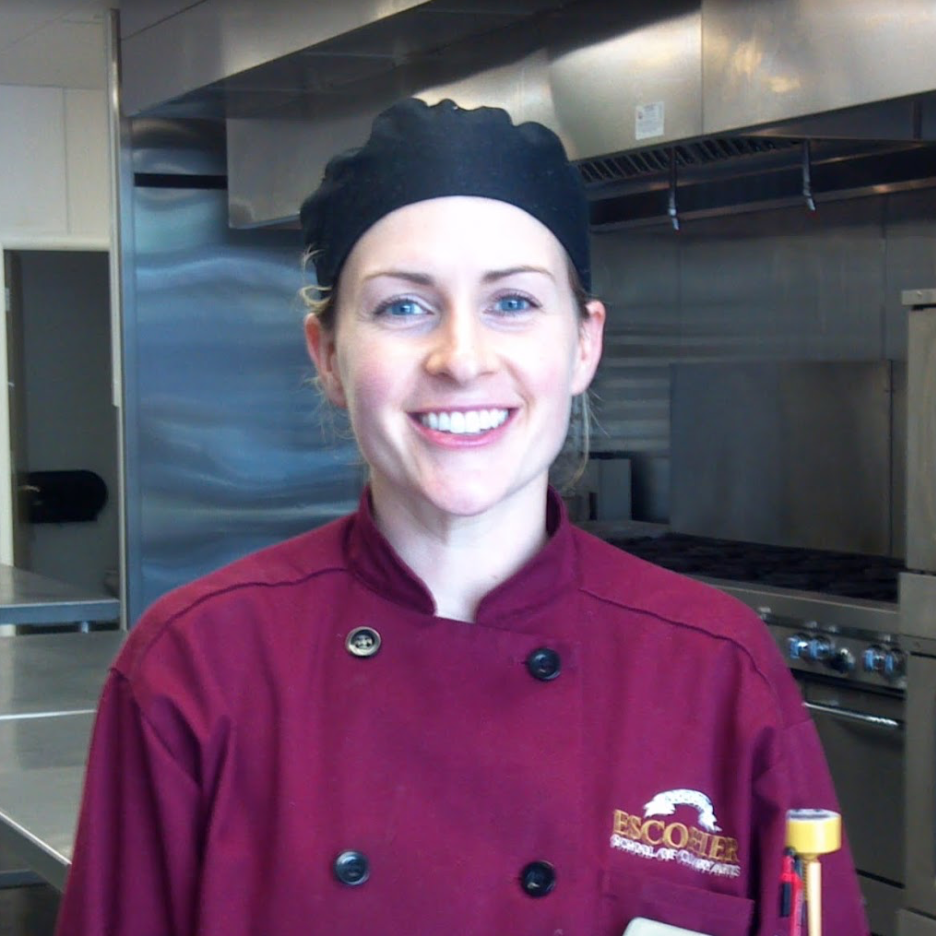
“Since the beginning of the admissions process I felt like everyone at the Auguste Escoffier School of Culinary Arts was personally interested in my success. Halfway through the Culinary Arts program, I continuously built on the strong foundation of skills emphasized from the start. Our Chef Educator had exceeded my expectations and drove a standard of personal excellence. While each classmate brought their own strengths, we were encouraged to collaborate and push one another to achieve our daily goals. I knew I would have the support of an amazing network ensuring my successful career upon completion of the program. I am extremely pleased with my choice to attend Escoffier.”*